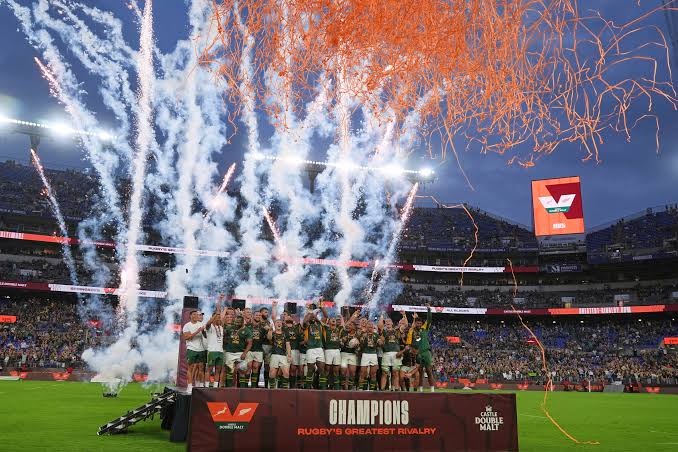

The Springboks and All Blacks went to America chasing revenue. They may have come back having discovered an entirely new business model for international rugby.
Baltimore was supposed to be an experiment.
By the time South Africa walked away from M&T Bank Stadium with a 43–28 victory over New Zealand, a 3–1 series win and another chapter added to rugby’s greatest rivalry, the experiment had begun to look much more like a blueprint.
Because the most important number from Baltimore may ultimately not be 43–28.
It may be $8 million.
Estimates before the match suggested South Africa and New Zealand could generate around $8 million more between them by playing the final Test in the United States than they would have earned from staging another fixture in South Africa. Other South African reporting placed the additional value even higher, estimating that each union could benefit by around R90 million compared with a conventional home Test.
Whichever final accounting figure emerges, the message is the same.
International rugby has discovered that its biggest matches may be worth considerably more when they travel.
A Rivalry Becomes an Asset
South Africa against New Zealand has always been one of rugby’s great sporting properties.
What Rugby’s Greatest Rivalry did was begin treating it like a commercial property.
The four-Test series revived the traditions of the old rugby tours — Tests surrounded by provincial matches, travelling supporters and weeks of sustained narrative — but wrapped them inside modern sports economics.
Revenue from the venture is being shared equally by SA Rugby and New Zealand Rugby. Reuters reported after the series that the new property had been judged a success and will return when South Africa tour New Zealand in four years.
That is significant.
The unions have effectively created intellectual property around something that previously existed largely as a fixture on an international calendar.
The NFL understands this principle. Formula One understands it. Boxing understands it.
Rugby has historically been much slower.
Baltimore suggests that is changing.
71,000 Seats Change the Equation
M&T Bank Stadium offered something few rugby unions can provide themselves: an NFL-scale venue inside the world’s richest sports economy.
More than 62,000 tickets had already been sold before matchday, breaking the previous North American record for a single rugby match, and post-match reports described a crowd around the stadium’s 71,000 capacity.
Average ticket prices were reported at around $200.
Add premium hospitality, food and beverage, sponsorship, merchandise, international broadcast income and the wider promotional value of taking two globally recognised teams into a new market, and suddenly a neutral-ground Test begins looking very different from an exhibition match.
It becomes an event.
That distinction matters.
For unions that do not own major stadiums, the economics of Test rugby are fundamentally different from England, where the RFU can generate around £10 million from a Six Nations home fixture at Twickenham.
South Africa and New Zealand do not possess that same stadium-backed revenue machine.
Their most valuable asset is therefore not necessarily the ground.
It is the team.
Baltimore showed what happens when that asset becomes portable.
The Six Nations Will Be Watching
This is where the story becomes much bigger than South Africa and New Zealand.
World Rugby is already exploring whether a future Six Nations match could be taken to the United States, with an Ireland–Italy fixture in Boston or New York used publicly as an example.
World Rugby chief executive Alan Gilpin made the commercial calculation explicit: if a union can at least match — or improve — what it would have earned from a home fixture, the financial barrier to exporting major Tests begins to disappear.
England is unlikely to volunteer because Twickenham is simply too valuable.
Italy might think differently.
Ireland might.
Other international unions certainly will.
The question is no longer whether taking a major Test overseas damages revenue.
Baltimore suggests it may increase it.
America Is the Prize — But Not Yet the Market
There is one enormous caveat.
A packed stadium does not mean rugby has conquered America.
Reuters reported before the Test that some of the biggest Springbok players could walk through Baltimore barely recognised. USA Rugby currently has just over 100,000 active participants and wants that figure closer to 500,000 by the time the men’s Rugby World Cup arrives in 2031.
That distinction is critical.
Rugby has demonstrated that America can support a premium rugby event.
It has not yet demonstrated that America can support rugby every week.
Those are entirely different propositions.
World Rugby knows it. Its new strategy includes approximately £200 million of investment into the US market before 2031, with the governing body targeting more than $1 billion in surplus from the 2031 Rugby World Cup to reinvest in the global game.
Baltimore therefore was not an isolated adventure.
It was market research conducted in front of tens of thousands of paying customers.
Rugby’s New Export Economy
There will be resistance.
Supporters will rightly argue that national teams belong at home. A South African fan in Johannesburg loses something when the All Blacks play in Maryland rather than Ellis Park. An Italian supporter would have every right to question why a Six Nations home match had moved to Boston.
The danger is obvious: chase the highest bidder too aggressively and rugby risks turning national teams into travelling entertainment brands detached from the communities that built them.
But the opposite danger is equally real.
Professional rugby needs money.
Unions need new revenue.
Players cost more. High-performance programmes cost more. Women’s rugby requires greater investment. Developing markets need funding. Broadcast economics are changing.
Simply doing what rugby has always done will not necessarily finance what rugby wants to become.
Baltimore therefore matters because it offered something rugby desperately needs:
new money without inventing a new sport.
The rivalry remained authentic.
The stadium was full.
The television product looked major league.
The rugby delivered.
And both unions appear to have made considerably more money than they would have done by keeping the fourth Test at home.
That combination will not have gone unnoticed.
Baltimore may eventually be remembered for South Africa completing a 3–1 series victory over the All Blacks.
But inside rugby’s boardrooms, its legacy could be much bigger.
Because on one September night in an NFL stadium, two of rugby’s oldest nations demonstrated that the sport’s greatest rivalries are no longer simply matches.
They are global sports properties.
And that could change the economics of Test rugby forever.