
Executive Summary
New Zealand Rugby (NZR) presents one of the most paradoxical financial narratives in modern professional sport. By almost every commercial metric, the All Blacks remain an undisputed powerhouse: top-line revenue is at record levels, global brand equity remains peerless, stadium gates for Test matches are routinely sold out, a fresh broadcast deal is secured, and US private equity firm Silver Lake poured hundreds of millions into its commercial arm.
- 1. The Paradox of Prosperity
- 2. Where Does the Money Go? An Audit of Rugby’s Cost Architecture
- A. Elite Player Retention & Global Wage Escalation
- B. The Provincial Union Governance Subsidy
- C. Super Rugby Pacific’s Fragile Margin Model
- D. Extreme Geographical & Logistical Isolation
- E. Community Infrastructure & Grassroots Investment
- F. Expanded Commercial Overhead & Servicing Private Equity
- 3. The Strategic Question: Did Rugby’s Private-Equity Revolution Actually Fix Anything?
- 4. SportsRapt Intelligence Outlook: The Path to Structural Survival
Yet behind the iconic silver fern lies an unsustainable operational reality: projected multimillion-dollar deficits and internal mandates demanding NZ$20 million in annual cost savings.
This SportsRapt Intelligence investigation dissects where the money actually goes, evaluates the post-2022 private equity intervention, and addresses the broader strategic question facing global sport: Can private capital fix an international sports body if the underlying cost structures and governance models remain untouched?
1. The Paradox of Prosperity
To understand the current strain inside NZR, one must reconcile two seemingly contradictory realities:
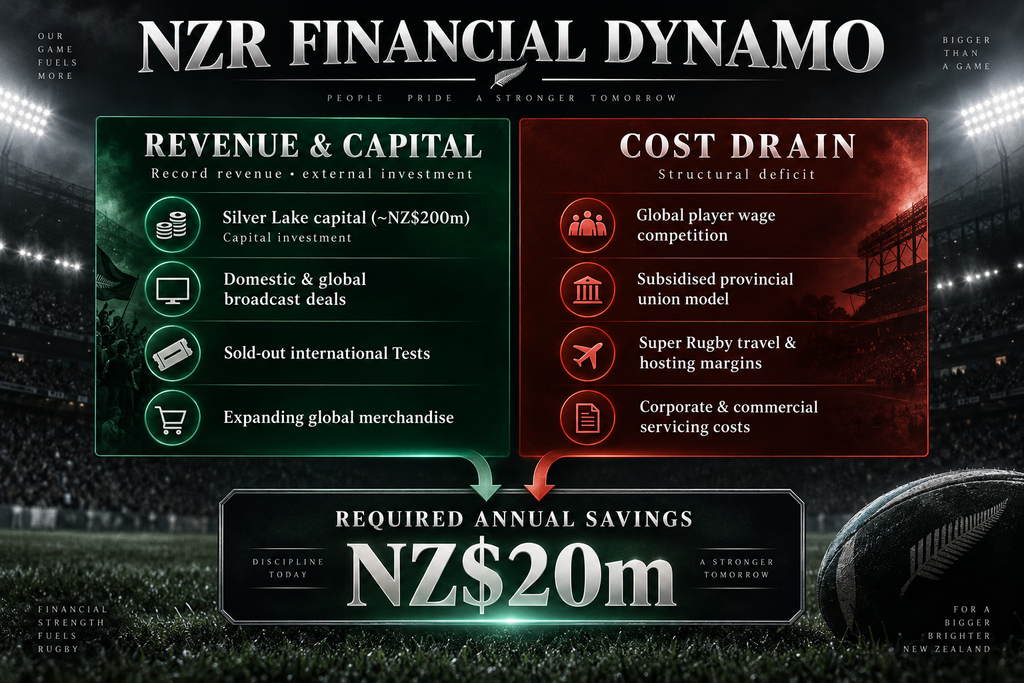
- The Commercial Peak: NZR’s commercial engine—NZR Commercial (NZRC)—has driven top-line revenue to historically high figures. Between global sponsorship portfolios, international exhibition fixtures, lucrative broadcast rights, and the initial cash injection from Silver Lake, NZR has never generated more top-line cash.
- The Fiscal Precipice: Despite these record revenues, the governing body faces structural annual operating deficits. Internal forecasts now warn that without immediate cost reductions—targeted at NZ$20m per year—cash reserves will erode at an unacceptable rate.
This disconnect demonstrates a classic financial trap: a top-line growth strategy operating on top of an inflated, rigid, and geographically disadvantaged cost base.
2. Where Does the Money Go? An Audit of Rugby’s Cost Architecture
Where does a national union generating hundreds of millions of dollars lose its margin? A line-item breakdown of rugby’s core operational expenses reveals six primary structural drains:
A. Elite Player Retention & Global Wage Escalation
The global market for elite rugby talent has hyper-inflated. Flush Japanese League One clubs, French Top 14 owners, and European syndicates offer tax-advantaged, multi-million-dollar contracts to top All Blacks. To keep its stars under direct contract—and eligible for the national side under NZR’s strict selection policy—NZR must spend heavily on top-tier retaining fees, performance bonuses, and sabbatical allowances.
B. The Provincial Union Governance Subsidy
Unlike centralized franchise leagues (such as North American sports leagues), NZR operates as a custodian of 26 individual Provincial Unions. Subsidizing provincial competition (National Provincial Championship / NPC) and administrative overhead across regional boards accounts for a massive, fixed annual commitment. A significant portion of national revenue is legally or politically tethered to keeping small regional unions solvent.
C. Super Rugby Pacific’s Fragile Margin Model
Super Rugby Pacific remains a brilliant talent incubator, but a challenging commercial engine. Broadcast yields have plateaued compared to Northern Hemisphere domestic leagues, and stadium receipts outside derby matches remain volatile. The tournament requires high operational expenditure without producing the per-game yields seen in European or Japanese domestic setups.
D. Extreme Geographical & Logistical Isolation
Southern Hemisphere rugby inherently incurs higher travel and operational costs than European competitions. Logistics, elite travel accommodations, medical support, high-performance staging camps, and international travel across Australasia, South America, South Africa, Europe, and North America represent millions in non-negotiable overhead annually.
E. Community Infrastructure & Grassroots Investment
As a national governing body, NZR cannot act purely as a commercial venture. It bears the solemn responsibility of funding schoolboy pipelines, referee associations, club rugby, safety protocols, and the rapid expansion of the professional women’s game (including the Black Ferns and Super Rugby Aupiki). While essential for the long-term health of the sport, community investment yields zero immediate financial return.
F. Expanded Commercial Overhead & Servicing Private Equity
Setting up and scaling an independent commercial entity (NZRC) to satisfy global growth ambitions requires substantial investment: specialized executive hiring, international marketing offices, agency commissions, and legal/financial servicing costs. To generate top-line growth, NZR had to spend heavily to build corporate infrastructure.
3. The Strategic Question: Did Rugby’s Private-Equity Revolution Actually Fix Anything?
In 2022, Silver Lake acquired a minority stake in NZR’s commercial arm for about NZ$200 million, valuing the commercial business at nearly NZ$2.4 billion. The premise was simple: bring Silicon Valley capital, network, and commercial discipline to monetize the All Blacks’ brand across global markets.
Four years later, the revenue figures show that Silver Lake fulfilled its primary promise: commercial revenue has increased materially.
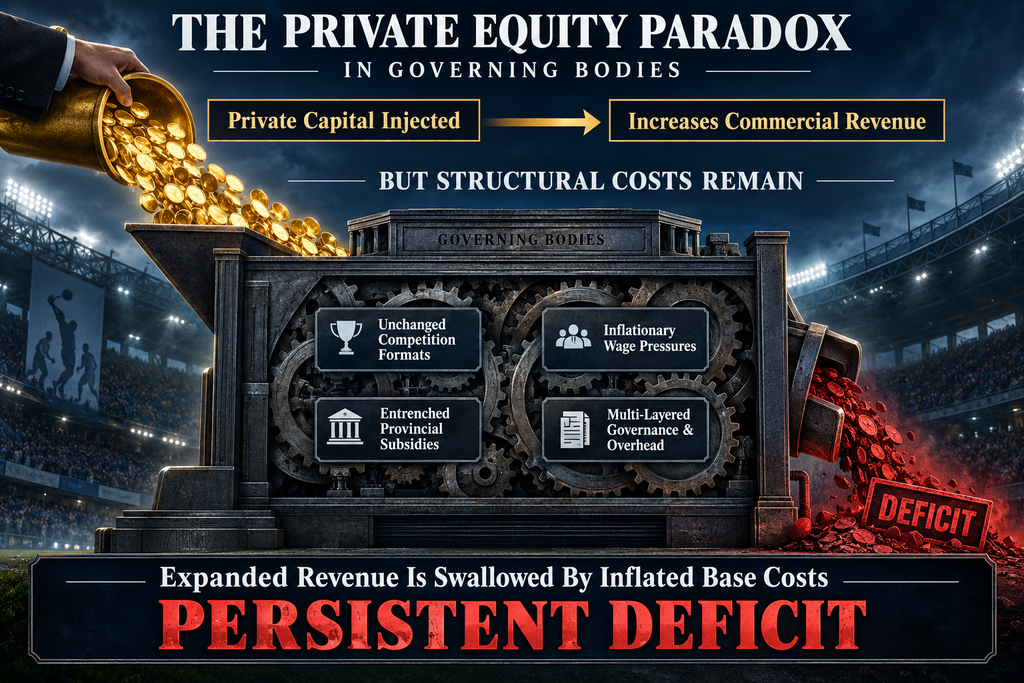
However, the current deficit proves a deeper economic truth: Private equity capital scales top-line revenue, but it cannot fix an inefficient cost structure or a broken governance model.
Why Capital Alone Doesn’t Solve the Problem:
- Capital vs. Governance: Silver Lake bought a stake in the commercial rights, not the governance or operational delivery of the sport. They do not dictate provincial union funding, high-performance player payment pools, or Super Rugby schedules.
- Cost Escalation Outpaces Revenue Growth: Every dollar of new revenue generated was instantly absorbed by escalating player costs, expanded corporate management, and inflation in team travel and operations.
- The Governance Bottleneck: Decisions regarding structural reform, tournament rationalization, and provincial consolidations require approval from a voting structure dominated by regional stakeholders hesitant to vote down their own funding.
4. SportsRapt Intelligence Outlook: The Path to Structural Survival
NZR’s demand for NZ$20m in annual savings marks the end of the “easy money” era. Injecting private equity buys time and builds commercial capabilities, but true fiscal stability requires tackling the structural core.
For New Zealand Rugby—and national sports bodies watching globally—the strategic imperatives are clear:
- Rationalize the Provincial Structure: Streamline NPC funding models and administrative overhead, shifting regional unions toward lean community-focused operations rather than quasi-professional money pits.
- Overhaul Super Rugby Pacific’s Economics: Redesign the competition format to lower travel costs, maximize broadcast appeal, and potentially integrate closer tie-ins with Asian or North American calendar windows.
- Decouple Revenue Generation from Cost-of-Sale: Standardize global exhibition matches and commercial tours to ensure high net margins, rather than high-gross, high-friction events.
- Align Player Yields with Realized Revenue: Modernize collective bargaining agreements (CBAs) so that player payment pools fluctuate organically with net operating surplus, rather than gross commercial projections.
The Bottom Line
The All Blacks remain an untouchable sporting brand, but an iconic jersey cannot balance a bank account on its own. Private equity provided the capital, but only structural reform can deliver survival. Until New Zealand Rugby addresses the entrenched costs of its domestic and international architecture, even record revenue will continue to vanish into the red.