




The modern European and cross-border rugby architecture resembles an intricate, high-stakes financial portfolio. Balancing regional identity against commercial scale, the sport’s multi-tiered system pits established aristocrats against dynamic disruptors. Across the primary regional engine—the United Rugby Championship (URC)—and its two European elite destinations—the Investec Champions Cup and the EPCR Challenge Cup—the operational dynamics reveal a compelling study in athletic performance, squad management, and economic gravity.
1. THE EDITORIAL PROFILE: DIVISIONS & REGIONAL SHIELDS
The Irish Shield: The Benchmark Standard
- Teams: Leinster, Munster, Ulster, Connacht
- Editorial Analysis: The undisputed powerhouse division of European rugby. Leinster functions like a national team in club kit—an elite, highly capitalized juggernaut that routinely tops domestic standings and reaches European finals. Munster supplies raw emotional grit and tactical steel, while Ulster and Connacht operate as dangerous, high-leverage disruptors capable of taking down any side on their day.
The South African Shield: The Physical Engine
- Teams: Vodacom Bulls, DHL Stormers, Hollywoodbets Sharks, Emirates Lions
- Editorial Analysis: The inclusion of South Africa’s elite franchises injected brutal physical size and gainline intensity into Northern Hemisphere rugby. The Bulls (Pretoria) and Stormers (Cape Town) have asserted themselves as perennial title contenders, leveraging high-altitude home fortresses and world-class Springbok power. The Sharks carry star-studded rosters with supreme upside, while the Lions continually outpunch their budget weight class with high-tempo, expansive rugby.
The Italian & Scottish Shield: The Modern Blueprint
- Teams: Glasgow Warriors, Edinburgh Rugby, Benetton Rugby, Zebre Parma
- Editorial Analysis: High-efficiency, tactically smart operators. Glasgow Warriors have unlocked genuine championship caliber, built on relentless speed and tactical precision. Edinburgh and Treviso’s Benetton Rugby have evolved from historic underdogs into ruthless home-ground operators capable of securing Champions Cup knockout berths. Zebre Parma remains in a rebuilding phase, serving as a developmental crucible for Italian youth talent.
The Welsh Shield: Fighting the Commercial Tide
- Teams: Cardiff Rugby, Ospreys, Scarlets, Dragons RFC
- Editorial Analysis: A division navigating significant structural turbulence and financial restructuring. While the Ospreys and Cardiff retain elite individual talent and deep international roots, Welsh regional rugby as a collective currently finds itself battling to bridge the financial gap separating them from the South African and Irish powerhouses.
2. THE WINNERS, THE LOSERS, AND THE NEWBIES

The Winners: European Aristocracy
At the pinnacle sit French powerhouses Union Bordeaux-Bègles (UBB) and Stade Toulousain, alongside Leinster and Glasgow Warriors. These franchises have deep talent pipelines and strong commercial backing, making them perpetual contenders for Champions Cup glory. Winning in this tier demands multi-international depth; squads must withstand mid-season Test absences without compromising their domestic campaign standings.
The Losers: Squeezed Mid-Table Operators
The primary losers in the current system are clubs trapped in structural or financial squeezes. Welsh regions (Dragons RFC, Scarlets) and mid-table English or French outfits face an unforgiving reality: lacking the squad depth to compete simultaneously across two brutal competitions, they often run into heavy squad attrition, rotational fatigue, and early European exits.
The Newbies & Invited Disruptors: Global Expansion
The introduction of wildcard and invitee entries into the EPCR Challenge Cup—most notably Georgia’s Black Lion and South Africa’s Toyota Cheetahs—represents one of rugby’s most fascinating structural experiments. Black Lion brings an uncompromising, international-caliber Georgian forward pack into the club ecosystem, while the Bloemfontein-based Cheetahs provide a high-scoring, high-altitude threat that expands the footprint of global cross-border competition.

3. THE ECONOMICS: LOGISTICS, TRAVEL & FINANCIAL COSTS
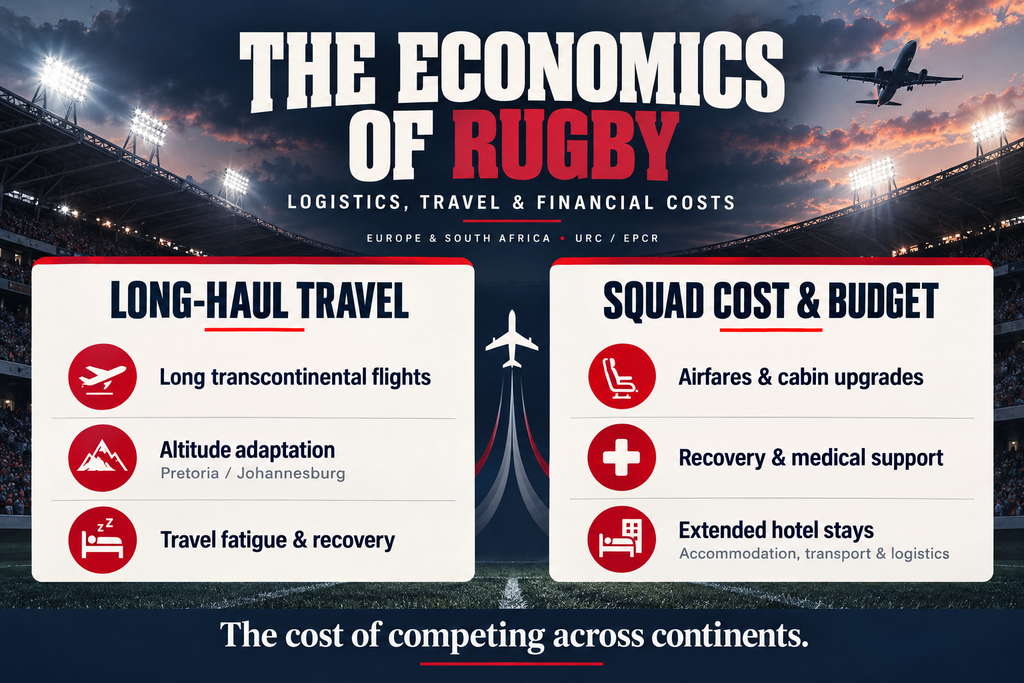
Behind the high-octane product on the pitch lies a punishing logistical and financial reality. The modern URC and EPCR ecosystem is unprecedented in professional team sports regarding geographic scale, stretching from Galway and Glasgow across the equator down to Cape Town and Durban.
The Logistics of Transcontinental Travel
- The South African Leg: European teams traveling to South Africa face 11-plus-hour flights and immediate environmental adjustments—jumping from Northern Hemisphere winter conditions to summer heat, plus the physiological challenge of playing at altitude at Loftus Versfeld (Pretoria) or Ellis Park (Johannesburg).
- The Northern Tour: Conversely, South African franchises undertake extensive multi-week travel blocks across Europe, requiring temporary operational bases in Ireland, Wales, Scotland, or Italy to minimize transcontinental back-and-forth flight fatigue.
Financial Escalation & Squad Costs
Operating in a global cross-border league carries steep overheads that directly impact club balance sheets:
- Travel Overhead & Flight Logistics: Charter flights, long-haul commercial bookings for 40-plus personnel (players, coaching staff, medical teams, analysts), and excess baggage fees for high-performance equipment represent major operational line items.
- Extended Hotel & Recovery Infrastructure: Multi-week touring blocks require prolonged hotel stays, specialized nutrition, and mobile sports-science recovery units (cryotherapy, hyperbaric treatment, specialized physiotherapy) to mitigate player load and injury risks.
- Squad Depth Requirements: To survive transcontinental travel and simultaneous domestic and European commitments, clubs can no longer rely on a starting 15. Success requires a deep, 45-man roster capable of squad rotation without dropping quality—a necessity that places immense pressure on player wage caps and academy investment.
More Read