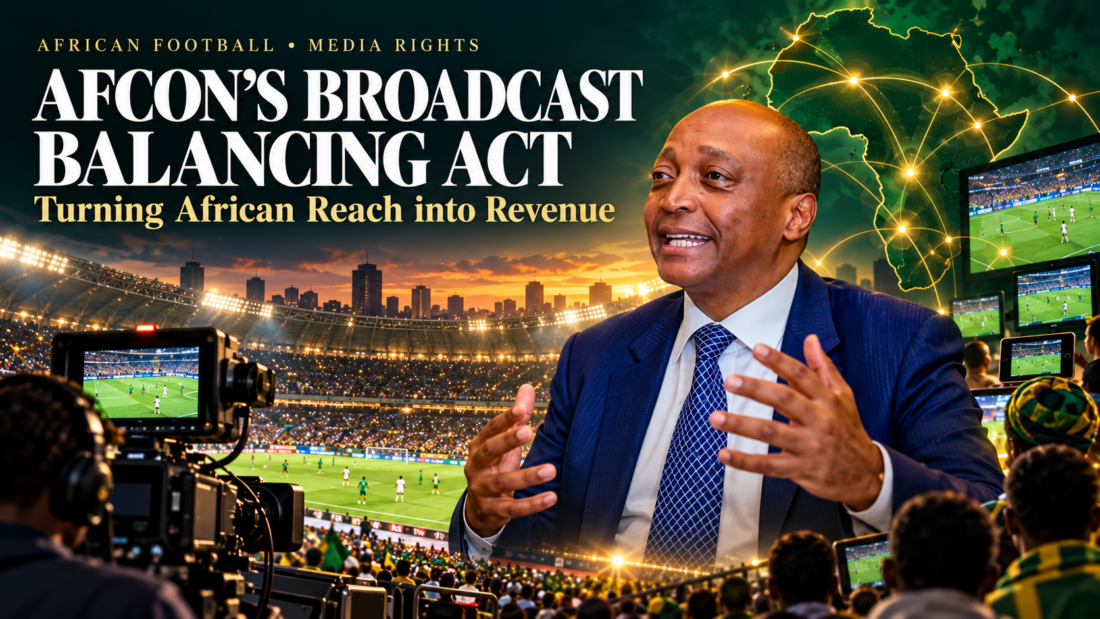

As qualifying begins for the 2027 tournament, CAF’s mix of subscription television and free-to-air coverage puts distribution at the centre of football’s commercial equation.
24 September 2026 | SportsRapt
Africa’s next major football business contest begins on television screens today. As qualifying opens for the 2027 Africa Cup of Nations, CAF’s confirmed broadcast arrangements combine international subscription operators with national broadcasters carrying selected matches. The commercial question is how successfully that distribution can generate income while keeping the competition accessible to the audiences that make it valuable.
In its broadcast announcement on 23 September, CAF confirmed beIN Sports coverage across the Middle East and North Africa and additional territories, alongside CANAL+ coverage in more than 30 sub-Saharan countries in French. Selected fixtures will also reach viewers through broadcasters including Côte d’Ivoire’s RTI, Cameroon’s CRTV and Botswana TV. The finals are scheduled for 19 June to 17 July 2027 in Kenya, Tanzania and Uganda.
For sponsors and rights buyers, this creates a more demanding calculation than counting the countries on a coverage map. A broadcast footprint establishes potential availability. It does not establish how many people watch, how long they stay or whether their attention produces a commercial return.
The distinction matters as CAF works through its wider rights programme. On 21 August, the governing body launched a sub-Saharan media tender covering the 2027 finals, their qualifying competition and several other tournaments. It offered free-to-air and pay-TV rights in languages including English, Swahili, Portuguese, isiZulu, Wolof and Yoruba, while excluding French-language pay-TV rights for the 2027 edition. The advertised submission deadline was 14 September.
Those details show the importance of territory and language in the sales process. They do not disclose the value of the resulting contracts. Neither the tender announcement nor this week’s viewing guide provides enough financial information to calculate CAF’s income from these arrangements, broadcaster margins or the allocation of advertising inventory.
The economic logic nevertheless deserves scrutiny. Subscription broadcasters seek programming that persuades customers to join, remain subscribed or buy a more expensive package. Free-to-air coverage can extend a competition’s visibility beyond households willing to pay for premium sport. For CAF, the opportunity is to combine rights income with an audience broad enough to support valuable sponsorship.
That balance requires careful contracting. Too much overlapping coverage can weaken the exclusivity for which a pay-TV operator is prepared to pay. Too little accessible coverage can restrict sponsor exposure. The strongest arrangement must specify which matches each partner receives, where they can be shown and what promotional material can circulate around them.
Language is another commercial variable. Local commentary offers broadcasters a way to make coverage more relevant to particular audiences and advertisers. But additional production has a cost. Buyers should test whether language-specific programming attracts incremental advertising commitments or improves customer retention before assuming that a wider offering will generate higher margins.
Competition for football attention is also intensifying. On 28 August, LaLiga announced that DAZN had secured rights to all 380 of its matches each season across 48 sub-Saharan markets, running from 2026/27 through 2028/29. The package includes live and on-demand coverage, with English and Spanish commentary. The announcement did not disclose the rights fee.
For African national-team football, that provides a useful commercial comparison. Imported club competitions can offer regular fixtures throughout a season. International qualifiers offer concentrated moments of national interest. Broadcasters must judge how those different viewing patterns contribute to subscription retention and advertising sales, rather than treating every live football hour as equally valuable.
Streaming adds further questions. A platform carrying a match still needs viewers to discover it, access it reliably and complete any required payment. Revenue forecasts should account for distribution and production costs, as well as customer acquisition. Subscription receipts are revenue; they become profit only after the costs of securing and serving that audience.
There is also a physical constraint beneath the television proposition. Reuters reported on 22 September that 12 countries must play home qualifiers at neutral venues because they lack stadiums meeting CAF’s requirements.
That displacement can weaken the local commercial opportunity surrounding a national team. A fixture staged abroad cannot automatically reproduce the ticket demand, hospitality market or sponsor activation programme available at home. Television may preserve access to the match, but it cannot replace every transaction that would have occurred around the stadium.
For sponsors, the practical response is to buy against documented delivery. Country-level broadcast confirmation should come before a continental campaign commitment. Agreements should distinguish match coverage from highlights and define the permitted use of footage. Audience reporting should separate television viewing, digital views and unique users rather than combining unlike measures into one impressive total.
Broadcasters, meanwhile, can reduce risk by securing advertiser commitments before expanding production budgets. Rights holders should examine payment security and distribution capability alongside the headline bid. A large contractual promise is valuable only if the buyer can fulfil it.
AFCON qualifying now supplies the live test. The enduring commercial prize is a competition that broadcasters can monetise, sponsors can measure and supporters can follow. Achieving all three will determine how much of African football’s attention becomes sustainable revenue.