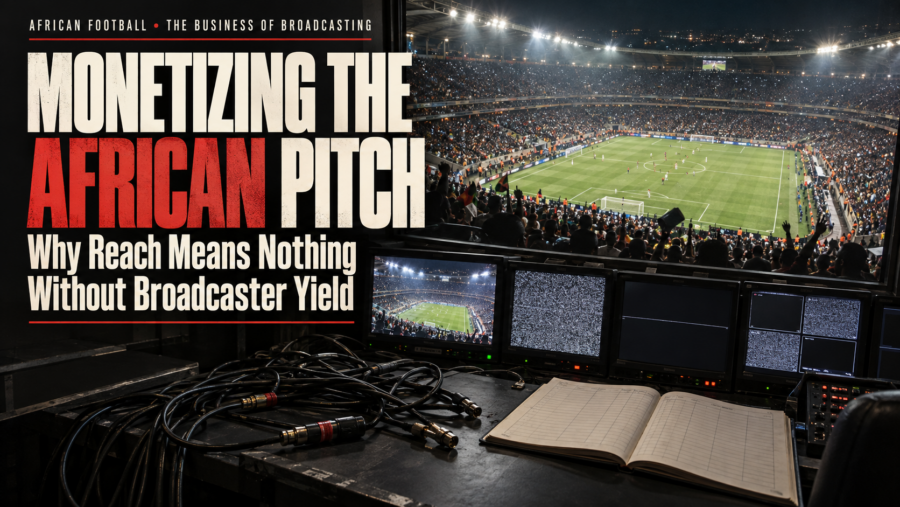

As 2027 AFCON qualifying opens, CAF’s fragmented patchwork of pay-TV, free-to-air, and homeless teams exposes the structural friction between raw audience size and true commercial enterprise value.
24 September 2026 | SportsRapt Editorial
Coverage maps are vanity metrics; cash conversion is reality. As qualifying opens for the 2027 Africa Cup of Nations (AFCON), the Confederation of African Football (CAF) faces a classic media trade-off: maximizing raw viewership while preserving the exclusivity required to command premium rights fees.
CAF’s September 23 broadcast architecture reveals a heavily segmented monetization model. MENA and select international markets remain anchored to beIN Sports, while CANAL+ holds French-language pay-TV dominance across more than 30 sub-Saharan nations. To prevent blackouts in key domestic markets, CAF carved out localized free-to-air (FTA) feeds to national networks, including Côte d’Ivoire’s RTI, Cameroon’s CRTV, and Botswana TV. On paper, this hybrid model secures pan-African visibility ahead of the June 2027 finals in Kenya, Tanzania, and Uganda. In practice, it compresses pay-TV pricing power.
The Unbundling Dilemma
This tension was explicit in CAF’s August 21 sub-Saharan media tender covering the 2027 finals and qualifying cycles. By unbundling English, Swahili, Portuguese, isiZulu, Wolof, and Yoruba rights across FTA and pay-TV while siloing French pay-TV, CAF attempted to engineer competitive bidding ahead of the September 14 deadline.
Yet headline tender interest obscures the primary commercial risk: counterparty execution. Without transparent deal structures, known broadcaster margins, or guaranteed ad inventory allocations, market participants cannot verify whether CAF is securing non-recourse revenue or simply carrying credit risk on overextended regional networks.

The European Competition Threat
CAF is not operating in a vacuum; it is competing directly for consumer subscription budgets. DAZN’s August 28 acquisition of sub-Saharan LaLiga rights—covering all 380 matches per season through 2028/29 with multi-language commentary across 48 markets—presents a structural challenge.
Imported club football offers networks year-round, predictable subscriber retention. AFCON qualifiers offer brief, high-intensity spikes in national interest. When pay-TV platforms overpay for non-exclusive or heavily fragmented national team rights, customer acquisition costs quickly outpace subscriber lifetime value ($LTV$).
Infrastructure Deficits and Capital Leakage
Compounding this broadcast friction is a severe physical infrastructure deficit. Reuters reported on September 22 that 12 qualifying nations must play home fixtures in neutral host countries due to non-compliant domestic venues.
Staging matches abroad guts the local commercial engine. Matchday ticketing evaporates, corporate hospitality is destroyed, and regional sponsor activations collapse. While a broadcast signal can transmit a neutral-venue match, a displaced federation converts zero physical yield, shifting the entire monetization burden onto media rights buyers.
The Strategic Execution Framework
To extract durable value from this environment, rights holders, broadcasters, and brand sponsors must enforce strict commercial discipline across three operational levers:
- For Sponsors: Enforce Audited DeliveryAbandon blanket coverage commitments. Tie sponsorship payouts to audited regional viewing figures, enforce clear contractual distinctions between live linear matches and digital highlights, and isolate unique active users from aggregated video impressions.
- For Broadcasters: De-Risk Upfront Production Costs. Pre-sell advertising inventory before expanding production budgets. While local-language commentary (e.g., Swahili or Yoruba feeds) expands addressable reach, production overhead scales rapidly. Networks must confirm incremental ad presales before committing capital to multi-audio operational footprints.
- For CAF: Audit Counterparty Solvency. Prioritize payment security and letter-of-credit guarantees over non-binding headline bid values. A massive contractual promise carries zero enterprise value if the rights buyer defaults mid-tournament under subscriber churn pressure.
AFCON qualifying is a live test of commercial design. The prize is not merely broad coverage, but a synchronized model where pay-TV platforms capture margin, sponsors measure precise return on capital, and federations build long-term enterprise value.