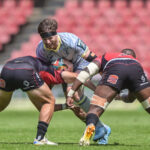



Australia delivered a thrilling victory. The systems supporting international rugby raised questions that organisers must answer before 2027.
The most uncomfortable image from Perth was a referee holding a mobile phone while an international rugby match waited for instructions.
Australia’s 42–38 victory over South Africa deserved attention for its attacking ambition and extraordinary defensive finish. Instead, part of the spectacle became an exercise in troubleshooting, with Andrea Piardi communicating by telephone after the officials’ communications equipment failed.
For rugby’s commercial leadership, that image should demand an explanation. A premium sporting product depends on confidence that its essential systems will work under pressure.
The timing matters. Perth will host the opening match of the 2027 Rugby World Cup; Sydney will stage the final. What happened on Sunday therefore raises a tournament-wide question: how convincingly can rugby guarantee continuity when its technology fails?
More Read

First, establish what happened.
The Associated Press reported that the final 20 playing minutes stretched to almost 35 minutes. That is different from claiming the final 15 took 40. An exact breakdown requires the match recording and official stoppage log, distinguishing technical delays from disciplinary reviews and other interruptions.
Nor is the identity of the person on the telephone an unresolved mystery. ABC’s live coverage identified TMO Matteo Liperini as Piardi’s counterpart. The available reporting supports communication between appointed officials. Evidence of a planned disruption or outside interference: insufficient information.
More Read

That distinction protects the credibility of the investigation. Suggesting skulduggery without evidence gives administrators an easy reason to dismiss legitimate operational questions.
The phone’s presence also does not establish illegality. World Rugby’s Law 6 authorises TMO involvement and requires reviews to follow its protocol. It does not expressly prohibit a mobile handset. Whether this particular fallback complied with every applicable operational requirement needs confirmation from the organisers.
They should explain who authorised it, whether the conversation was recorded, and how the other officials remained informed. An improvised connection may preserve decision-making while weakening its transparency.
The clock issue deserves equal scrutiny.
Rassie Erasmus acknowledged that some clocks continued running when they should have stopped, while accepting responsibility for South Africa’s defeat. That supports concern about timekeeping displays; it does not establish that the official score was wrong or that playing time was improperly removed.
Under Laws 5 and 6, timekeeping belongs to the referee or an appointed timekeeper, and the referee keeps the score. Organisers should reconcile the authoritative match record with stadium and broadcast displays, explaining every discrepancy. Spectators should never have to guess which clock governs the contest.

Did the disruption change the outcome?
Interruptions can give defenders recovery time and break attacking rhythm. Reviews can also identify infringements that would otherwise escape sanction. These effects pull in different directions. Quantifying their net influence on this result: insufficient information.
Australia had built a 42–17 lead before South Africa’s late recovery. Erasmus explicitly said the technological problems did not explain his team’s performance. Any serious assessment must preserve that context.
The commercial damage requires similar discipline.
A camera lingering on a referee does not automatically translate into lost advertising revenue. Broadcasters may retain viewers through a dramatic finish; perimeter branding can remain visible during stoppages. Conversely, prolonged uncertainty can weaken attention and displace scheduled programming.
A defensible loss calculation needs audience retention data, advertising delivery records and contractual obligations. A monetary figure for Perth: insufficient information.
The business risk is nevertheless clear. Sponsors buy association with a compelling experience. Unexplained interruptions risk making operational incompetence part of that association. Persistent failures would give commercial partners grounds to demand stronger delivery guarantees.
Calling this “teething” is premature. Calling the entire system broken also exceeds the evidence. A failure occurred; its cause and the adequacy of its backup arrangements require investigation. The stadium, event organiser and communications suppliers should establish responsibility rather than allow the venue’s name to absorb every accusation.
What happens if this occurs during a World Cup final?
The laws permit consultation stoppages and allow suspension or termination where continuing would be unsafe. They do not prescribe an indefinite wait for a radio connection. Tournament organisers must explain the applicable contingency arrangements before that judgment becomes necessary.
World Cup readiness should include rehearsed communications failures, an independently functioning backup and clear announcements explaining delays. An incident report should identify the fault, assign responsibility and demonstrate that corrective measures work under match conditions.
For supporters, uncertainty is the corrosive element: watching decisions unfold without understanding why play has stopped or how much time remains.
Australia earned its celebration. Rugby’s administrators must now earn confidence in the machinery supporting it.