


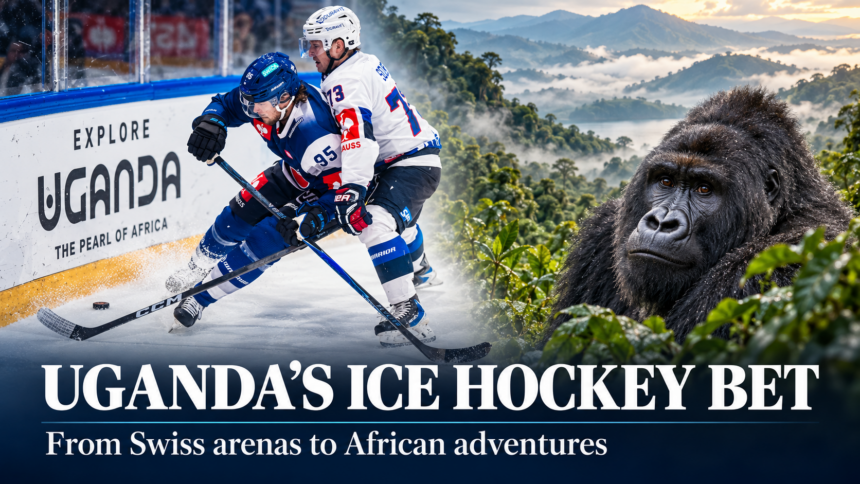
Uganda has made one of the boldest, most counter-intuitive sponsorship plays African tourism has seen in years: a one-year partnership with the Champions Hockey League, aimed squarely at Swiss sports fans. It is not a vanity project. It is a calculated attempt to convert a wealthy, travel-hungry European audience into high-value visitors to the Pearl of Africa.
The deal covers the 2026–27 CHL season and was concluded by the Uganda Tourism Board with Uganda’s embassy in Switzerland, with Infront facilitating the arrangement. Uganda will receive nationwide visibility in Switzerland and activation opportunities across the competition. What has not been disclosed is equally important: the rights fee, media inventory, hospitality allocation, production spend and any performance guarantees.
That absence turns this from a simple sponsorship story into a commercial test case. Uganda is not buying ice hockey because it expects Zurich teenagers to abandon the rink for gorilla trekking. It is buying access to a specific, affluent national market with an established winter-sports culture and a serious appetite for international travel.
The opportunity is real. Swiss residents reportedly spent around $23 billion on travel abroad in 2024. Yet Uganda’s Directorate of Citizenship and Immigration Control recorded just 106 Swiss tourist arrivals that year. That is not a market failure; it is an enormous commercial gap.
DO YOU NEED RESEARCH MATERIAL FOR BETTER BUSINESS LEVERAGE – OUR TEAMS CAN HELP

Uganda’s tourism sector generated a reported $1.62 billion in receipts in 2025, a 21.3% increase on the previous year. International arrivals rose 19.7% to 1,642,215, with average expenditure of roughly $986 per trip and an average stay of 8.8 nights. Those are healthy foundations. But the Swiss number exposes the scale of the untapped prize.
Put simply: if Uganda added 1,000 Swiss visitors spending at the national average, it would generate close to $1 million in gross tourism receipts. That money would flow through airlines, lodges, tour operators, national parks, restaurants, transport businesses and local communities. It would not be profit for the Uganda Tourism Board, but it would be meaningful economic impact.
This is why the CHL partnership deserves more respect than the usual knee-jerk reaction to an unusual sports tie-up. Too many destination campaigns buy broad football exposure and then struggle to explain who saw the advert, where they live, or whether they ever considered booking a trip. Uganda has chosen something narrower: one country, one sport with genuine cultural resonance, and one clearly defined audience.

Switzerland is not a random target. It is one of Europe’s wealthiest outbound travel markets, with consumers accustomed to paying for premium experiences. Uganda’s proposition—gorilla trekking, wildlife, rafting on the Nile, hiking, birding, culture and conservation—can be positioned as the ultimate contrast to alpine familiarity. The creative challenge is to make that leap feel natural rather than forced.
Ice hockey fans will not become African tourists because they see a logo on an arena board. They will become prospects if the campaign connects the intensity and outdoor identity of the sport to specific Ugandan experiences, then gives them an immediate route from inspiration to itinerary, pricing and booking. Every asset must work harder than a brand placement.
Distribution will decide whether this becomes precision marketing or expensive wallpaper. Uganda needs Swiss travel agencies, German, French and English-language content, credible operators, clear flight information and bookable packages. A dedicated Swiss campaign page, downloadable itineraries, competitions and trackable partner links would allow UTB to build first-party data rather than surrender the audience to broadcasters and social platforms.
Measurement must be equally disciplined. Swiss website traffic, enquiries, operator referrals, campaign codes, visa data and eventual arrivals should all be tracked before, during and after the season. If hospitality or ticketing assets are included, UTB should use them to bring Swiss travel agents, media and corporate partners closer to the product.
The league and Infront also benefit. This agreement shows that a European sports property can package its audience geographically and sell it to a destination seeking access to a particular market. A sponsor does not need to sell hockey sticks, insurance or beer. It can sell a country.
But Uganda must demand verifiable Swiss delivery. Pan-European impressions are not Swiss exposure unless the audience can be separated by territory. Television reach, digital viewing, on-screen branding, activation participation and audience demographics should be independently reported.
More Read

The one-year term limits downside risk but compresses the runway. Safari and adventure travel involve long consideration cycles. The real return may only become visible months after the final puck drops.
Uganda’s ice hockey bet is unconventional because it refuses to follow the obvious script. Its logic is sharper than many prestige sponsorships: identify a wealthy but underdeveloped source market, acquire a platform that matters there, and convert attention into high-value visits.
The decisive numbers will not be arena boards or broadcast impressions. They will be Swiss enquiries, confirmed bookings, arrivals and expenditure—after the full campaign cost is deducted. Until UTB publishes those figures, this remains a promising marketing investment, not proof of tourism return.